
110年:內專
Struvite stones occurs in patients of repeated urinary tract infections (UTI) from bacteria that produce the enzyme urease, including both gram-positive and gram-negative species. Which is the least possible micropathogen causing struvite stone and repeated UTI?
AKlebsiella spp。
BEscherichia coli。
CMycoplasma spp。
DStaphylococcus epidermidis。
EProteus。
詳細解析
本題觀念:
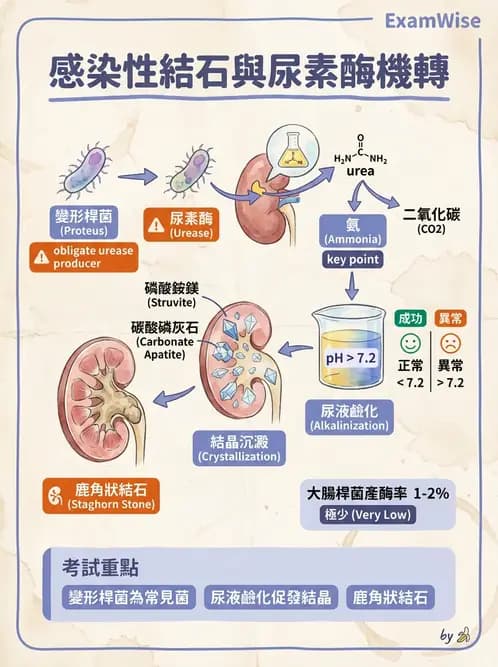
探討感染性結石(struvite stones,又稱感染性尿路結石)之形成機轉:須有能分解尿素(urease)的細菌,藉由尿素分解產生氨和二氧化碳,提升尿液 pH 值(至約7.2–8.0),使鎂、銨、磷酸根結晶沉澱形成 magnesium ammonium phosphate(struvite)及 carbonate apatite。
選項分析
-
選項A Klebsiella spp.
Klebsiella pneumoniae 具有 urease 活性,多數臨床菌株能分泌 urease,使尿液鹼化,促成 struvite 結石生成;為感染性結石常見致病菌之一。 -
選項B Escherichia coli
雖為最常見 UTI 致病菌,卻極少數菌株(約1–2%)具有 urease 活性,不足以持續維持尿液鹼化,故極少引起感染性結石;主要與 calcium oxalate 結石相關,非典型 urease 產生者。 -
選項C Mycoplasma spp.
部分 Mycoplasma(如 Ureaplasma urealyticum)能產生 urease,使尿液鹼化,臨床曾見感染性結石患者分離到此類菌株,故仍具致石可能。 -
選項D Staphylococcus epidermidis
Sta
...(解析預覽)...
升級 VIP 解鎖圖文解析