
109年:內專
一位52歲多年高血壓的病人,這次因malignant hypertension (systolic BP 210 mmHg)被送至急診,身體 檢查: edema (3+), creatinine 1.4 mg/dL。病人接受腎臟生檢(renal biopsy),以下臨床與病理變化敘 述,何者最正確? (1) 腎臟病理切片: Fibrinoid necrosis and medial hypertrophy of small vessels (2) 腎臟病理切片: mesangial proliferation and cellular crescent formation (3) 腎臟病理切片: global sclerosis of glomerulus with pericapillary fibrosis (4) 腎臟病理切片: IgA or IgM immune deposition at glomerular area (5) 血液檢查: hypocomplementemia (low serum C3, low serum C4) (6) Urinalysis 有heavy proteinuria, 但很少有hematuria
A(1)+(3)+(6)
B(1)+(2)+(3)+(4)+(6)
C(1)+(2)+(5)+(6)
D(1)+(4)+(5)
E(1)+(2)+(3)+(4)+(5)
詳細解析
本題觀念:
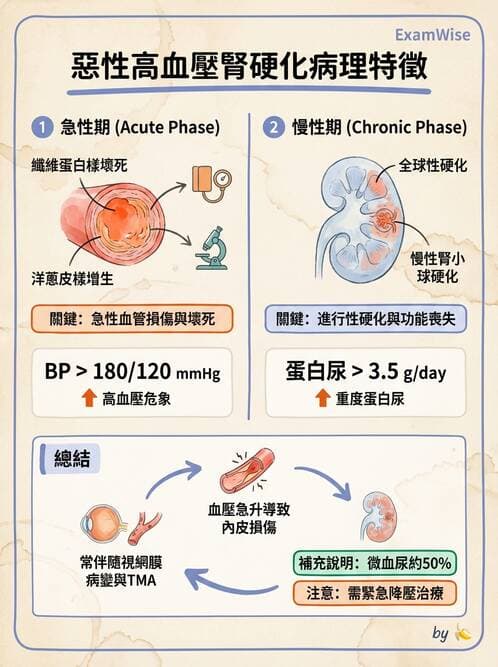
本題核心在於惡性高血壓(malignant hypertension)對腎臟造成的病理及臨床表現,包括急性血管病變(fibrinoid necrosis、hyperplastic arteriolosclerosis)與因長期高血壓導致的慢性惡性或良性腎硬化改變,以及對尿液檢查中蛋白與血尿表現的影響。
選項分析
- 選項A:(1)+(3)+(6)
- Fibrinoid necrosis and medial hypertrophy of small vessels
惡性高血壓典型的急性病理所見,動脈小動脈及小動脈出現纖維蛋白樣壞死,兼有平滑肌細胞增生(onion-skin hyperplasia)(elsevier-elibrary.com)。 - Global sclerosis of glomerulus with pericapillary fibrosis
長期高血壓或良性腎硬化常見的慢性變化,包含全球性硬化及周毛細血管纖維化,與動脈硬化造成的缺血性萎縮相符([en.wikipedia.o
- Fibrinoid necrosis and medial hypertrophy of small vessels
...(解析預覽)...
升級 VIP 解鎖圖文解析