
108年:(醫檢)血液(2)
有關肝素治療五天後引起之血小板減少症的致病機轉,下列何者正確?
A過量 heparin 透過 thrombomodulin 活化 thrombin ,進而活化血小板
B過量 heparin 與GPIIb/IIIa 結合,進而活化血小板
C過量 heparin 與VWF 結合,形成大量 Ultra-large VWF ,進而活化血小板
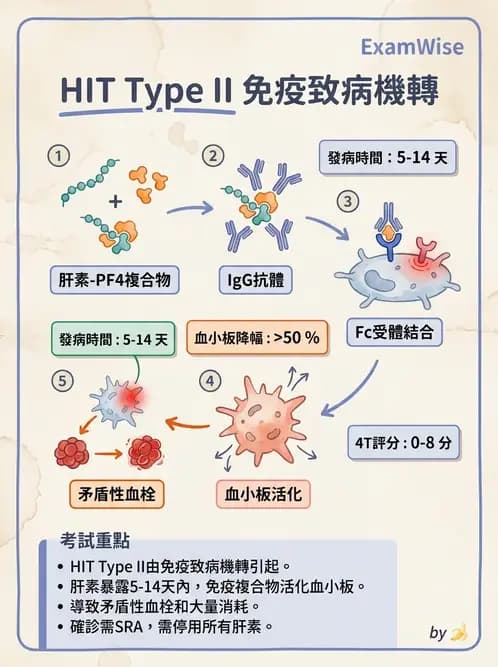
D引起免疫抗體 產生,進而活化血小板
詳細解析
本題觀念:
肝素誘導性血小板減少症(heparin-induced thrombocytopenia, HIT)是使用肝素治療後 5–14 天內出現的免疫性血小板減少併發症,屬於 HIT Type II(免疫型,與 Type I 非免疫型不同)。本題考其核心致病機轉。
選項分析
(A) 過量 heparin 透過 thrombomodulin 活化 thrombin,進而活化血小板 ❌ 此為錯誤敘述。Thrombomodulin 的實際作用是抑制凝血:Thrombomodulin 與 thrombin 結合後,使 thrombin 活化 Protein C,進而抑制凝血因子 Va 和 VIIIa。Heparin 的抗凝作用是透過活化抗凝血酶(antithrombin),而非 thrombomodulin。此選項機轉描述完全錯誤。
(B) 過量 heparin 與 GPIIb/IIIa 結合,進而活化血小板 ❌ Heparin 不直接與血小板 GPIIb/IIIa 結合。GPIIb/IIIa(αIIbβ3)是纖維蛋白原受體,不是 HIT 的作用靶點。
(C) 過量 heparin 與 VWF 結合,形成大量 Ultra-large VWF,進而活化血小板 ❌ 此描述混淆了 HIT 與 TTP 的機轉。HIT 的致病機轉與
...(解析預覽)...
升級 VIP 解鎖圖文解析