
107年:(醫檢)病生理(2)
下列何者在螢光顯微鏡鏡檢下,其免疫抗體呈現線狀沉積在腎絲球基底膜( basement membrane )?
A膜性腎病( membranous nephropathy )
BGoodpasture 氏症候群( Goodpasture syndrome )
C局部分節性腎絲球硬化( focal segmental glomerulosclerosis )
D膜性增殖性腎絲球腎炎( membranoproliferative glomerulonephritis )
詳細解析
本題觀念:
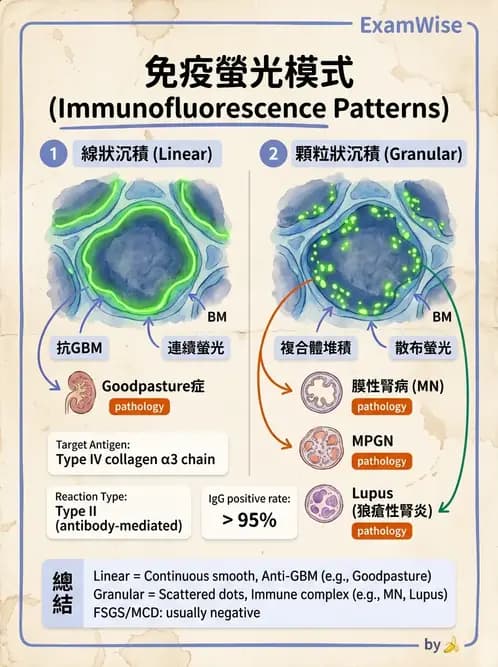
螢光顯微鏡下腎絲球基底膜(glomerular basement membrane, GBM)呈現**線狀(linear)**免疫抗體沉積,是 Goodpasture 氏症候群(Goodpasture syndrome)的病理特徵,由抗 GBM 自體抗體(anti-GBM antibody)直接與基底膜上連續分佈的抗原結合所致。
選項分析
(A) 膜性腎病(membranous nephropathy)
錯誤。膜性腎病的螢光顯微鏡特徵是**顆粒狀(granular)**沉積,沿腎絲球毛細管壁排列(IgG 為主,常為 IgG4 dominant),是免疫複合體沉積在上皮下(subepithelial)所形成的顆粒狀外觀,非線狀。
(B) Goodpasture 氏症候群(Goodpasture syndrome)✓
正確。Goodpasture 症候群是第 II 型(抗體媒介型)過敏反應,循環中的 IgG 自體抗體(anti-GBM IgG)直接針對 GBM 上的 α3 鏈第 IV 型膠原蛋白(type IV collagen α3 chain)。由於抗原在基底膜上均勻連續分佈,抗體沉積後在螢光顯微鏡下呈現**平滑、連續的線狀(smooth linear)**螢光。
(C) 局部分節性腎絲球硬化(fo
...(解析預覽)...
升級 VIP 解鎖圖文解析