
108年:骨科物治(1)
下列肩部病變與特殊測試之組合,何者正確?
A肱⼆頭肌斷裂-空罐測試( empty can test )
B肩夾擠症候群-驚恐測試( apprehension test )
C肩旋轉肌斷裂-前抽拉測試( anterior drawer test )
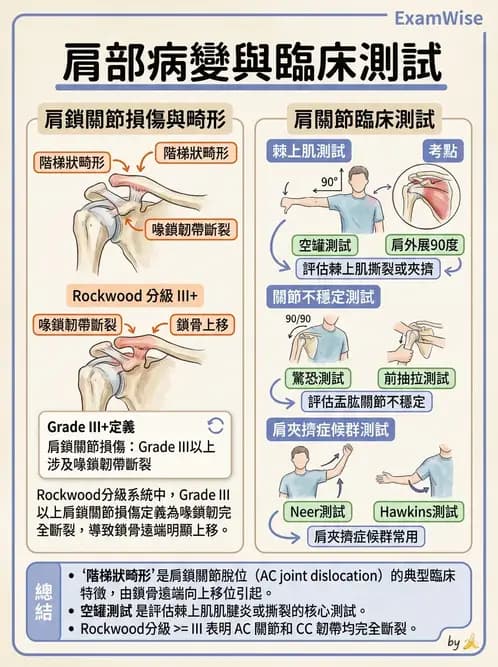
D喙鎖韌帶斷裂-梯狀變形( step deformity )
詳細解析
本題觀念:
肩部各種特殊測試(special tests)與其對應的病理診斷配對,重點在於正確辨識各測試適用的診斷目標。
選項分析
(A) 肱二頭肌斷裂-空罐測試(empty can test) 配對錯誤。 空罐測試(empty can test,又稱 Jobe's test)是用於評估**棘上肌(supraspinatus)**撕裂或夾擠,受測者肩外展 90 度、水平前屈 30 度(肩胛骨平面)並將大拇指朝下(如倒空罐子的動作),測試者施加向下阻力,若出現疼痛或無力則為陽性。與肱二頭肌斷裂無關。
(B) 肩夾擠症候群-驚恐測試(apprehension test) 配對錯誤。 驚恐測試(apprehension test)是用於評估盂肱關節前向不穩定(anterior glenohumeral instability),在肩外展 90 度 + 外轉時施加向前推力,若患者出現恐懼/警戒感則為陽性。此測試與夾擠症候群的評估無關(夾擠測試應為 Neer test 或 Hawkins-Kennedy test)。
(C) 肩旋轉肌斷裂-前抽拉測試(anterior drawer test) 配對錯誤。 前抽拉測試(anterior drawer test)是用於評估**盂肱關節前向不穩定(anterior i
...(解析預覽)...
升級 VIP 解鎖圖文解析