
105年:內專
Which statement regarding Lithium-associated nephropathy is not correct ?
AMost of the patients presented as oliguric acute renal failure
BProlonged (>10-20 years) lithium use, or those experienced repeated episodes of toxic lithium levels, may develop chronic tubulointerstitial nephritis
CThe most prudent approach is to monitor lithium levels frequently and adjust dosing to avoid toxic levels
DIn patients with significant proteinuria, ACEI or ARB treatment should be helpful
Etypical findings on renal biopsy are interstitial fibrosis and tubular atrophy
詳細解析
本題觀念:
本題為反向題(not correct),考查鋰鹽(lithium)相關腎病變的臨床特徵、病程及處置。鋰鹽是雙極性情感疾患(bipolar disorder)的重要治療藥物,其腎臟毒性是臨床重要議題。
選項分析
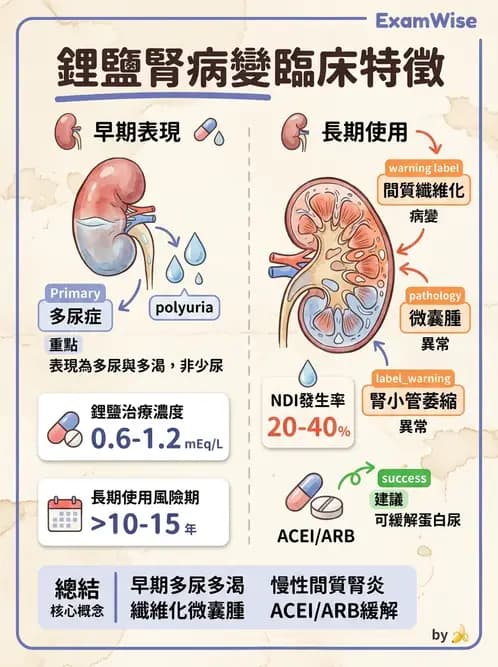
(A) 大多數病患表現為少尿性急性腎衰竭(oliguric acute renal failure) 此陳述不正確。鋰鹽腎病變最常見的早期腎臟表現是腎因性尿崩症(nephrogenic diabetes insipidus, NDI),導致多尿(polyuria)而非少尿。約 20-40% 長期使用鋰鹽的病患會出現 NDI,表現為多尿、多渴(polydipsia),24 小時尿量常超過 3 L。大多數病患的腎功能惡化是慢性漸進性的,並非以少尿性急性腎衰竭表現。❌ 不正確(正確答案)
(B) 長期(>10-20 年)使用鋰鹽,或曾有反覆鋰鹽毒性發作者,可能發展為慢性腎小管間質性腎炎(chronic tubulointerstitial nephritis) 此陳述正確。長期鋰鹽使用(通常 >15 年)可導致慢性腎小管間質性腎炎,腎臟切片可見間質纖維化(interstitial fibrosis)、腎小管萎縮(tubular atrophy)及腎小管囊腫(tubular microcy
...(解析預覽)...
升級 VIP 解鎖圖文解析