
106年:(醫檢)免疫病毒(2)
Graves' disease 最具特異性的自體抗原為何?
Athyroxine (T4 )和triiodothyronine (T3 )
Bsecond colloid antigen
Cthyroid stimulating hormone receptor
Dthyroid microsome
詳細解析
本題觀念:
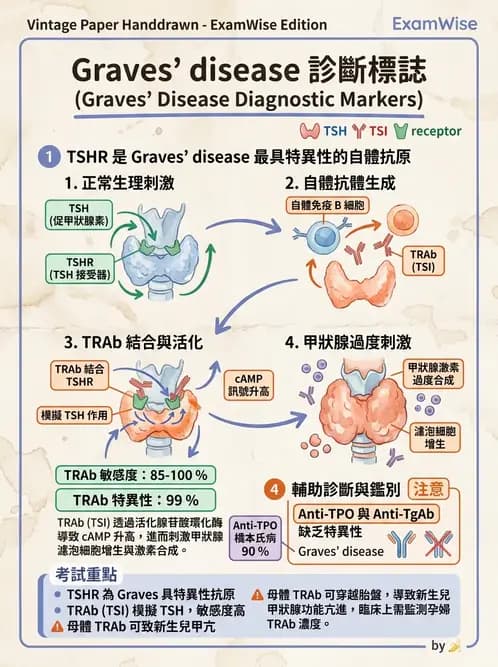
葛瑞夫茲病(Graves' disease)是最常見的自體免疫性甲狀腺功能亢進症,其病理機制在於自體抗體攻擊甲狀腺相關抗原。本題考查各種甲狀腺自體抗原對 Graves' disease 的特異性,核心在於辨別「哪種抗原/抗體最能代表 Graves' disease 的特異性病理」。
選項分析
(A) thyroxine(T4)和 triiodothyronine(T3) T4(四碘甲狀腺素)和 T3(三碘甲狀腺素)是甲狀腺分泌的激素,並非 Graves' disease 的自體抗原。雖然 Graves' disease 導致 T3/T4 升高,但針對這兩種激素本身的抗體並非其致病抗體。
(B) second colloid antigen 第二膠質抗原(second colloid antigen,即 CA2)是一種存在於甲狀腺濾泡膠質中的蛋白,其對應抗體(anti-CA2)在部分自體免疫性甲狀腺疾病可見,但對 Graves' disease 並無特異性。
(C) thyroid stimulating hormone receptor 促甲狀腺素接受器(thyroid stimulating hormone receptor, TSH receptor, TSHR)是 Graves' disease 最具特異性的自體抗原。
...(解析預覽)...
升級 VIP 解鎖圖文解析