
110年:內專
A middle aged woman was referred to renal clinic for evaluation of her renal disorder. She had intermittent pre-tibial swelling for almost 3 months. She has mild hypertension, but no diabetes. Neither viral hepatitis B nor C history. Laboratory tests were: albumin 3.1 g/dL, creatinine 1.7 mg/dL, Both serum complement levels (C3 and C4) are low, with a particularly depressed C4 compared with C3. Which of the following should be considered ?
ACryoglobulinemia。
BPost-streptococcal glomerulonephritis。
CMembranoproliferative glomerulonephritis。
DLupus nephritis, stage III or V。
EInfectious endocarditis or shunt nephritis。
詳細解析
本題觀念:
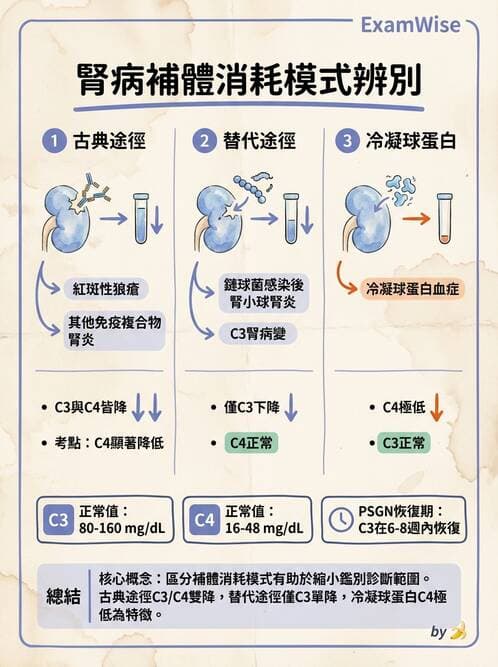
本題核心在於「補體消耗模式」與「免疫複合物性腎病變」的鑑別。不同腎臟病因會啟動不同補體途徑,呈現特定 C3、C4 水準變動:
• 古典途徑活化(免疫複合物介導):C4 與 C3 均下降,但 C4 降幅通常更顯著
• 替代途徑活化:C3 下降而 C4 正常
透過補體模式的辨識,可縮小鑑別範圍,方向指向如 cryoglobulinemia、lupus nephritis、MPGN 等免疫複合物性病因。
選項分析
-
選項A Cryoglobulinemia
• 類型II/III cryoglobulinemia 為混合型免疫複合物性疾病,強烈活化古典途徑
• 補體檢驗:C4 幾乎枯竭(極度低下),C3 亦偏低但降幅相對較小,呈現 C4 disproportionately 更低的模式,與題幹「C4 particularly depressed compared with C3」完全吻合
• 臨床:浮腫、輕度高血壓合併低蛋白血症,符合患者慢性腎病表現 -
選項B Post-streptococcal glomerulonephritis
• 主要透過替代途徑活化消耗 C3,C4 保持正常
• 病程短,C3 約 6–8 週內即可恢復,不符合本題 3 個月慢性經過 -
選項C Mem
...(解析預覽)...
升級 VIP 解鎖圖文解析