
107年:內專
某位CKD stage 5的病人,[Ca] 8.7 mg/dL, [P] 6.8 mg/dL。 下列有關腎性骨病變的敘述,何者不正確?
AHyperphosphatemia stimulates increasing plasma level of PTH (parathyroid hormone)
BLow serum [Ca] level, and reduced FGF-23 (fibroblast growth factor 23)production contribute to renal bone disease
CNephron loss reduces synthesis of 1,25-Vitamin D₃
DLow level of 1,25-Vitamin D₃ results in lower intestine resorption of Ca
EPhosphate retention contributes to hypo[Ca]
詳細解析
本題觀念:
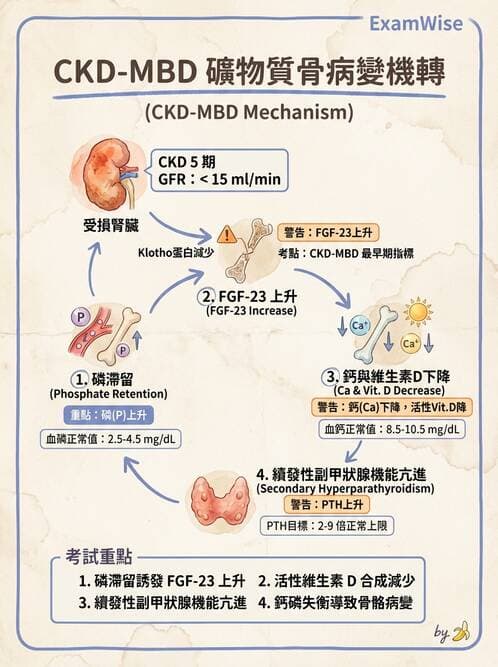
CKD–MBD(Chronic Kidney Disease–Mineral and Bone Disorder)在終末期腎病(ESRD)患者中常見,主要涉及腎臟合成活性維生素D(1,25-dihydroxyvitamin D3)減少、磷代謝異常、FGF-23及PTH調控失衡,最終導致腎性骨病變及相關併發症。
選項分析
-
選項A
高磷血症會刺激副甲狀腺素(PTH)分泌,機轉包含:一方面磷離子可直接作用於副甲狀腺細胞增加PTH釋放,另一方面磷與鈣結合使游離鈣下降,透過CaSR間接促進PTH分泌,並引發副甲狀腺增生 (ncbi.nlm.nih.gov, ncbi.nlm.nih.gov)。 -
選項B
此題主張「低血鈣及FGF-23降低」共同導致腎性骨病。事實上,CKD早期即出現FGF-23顯著上升以促進磷排泄,並抑制1α-hydroxylase活性,使活性維生素D下降。FGF-23並非減少,而是顯著增加 ([revistanefrologia.co
...(解析預覽)...
升級 VIP 解鎖圖文解析